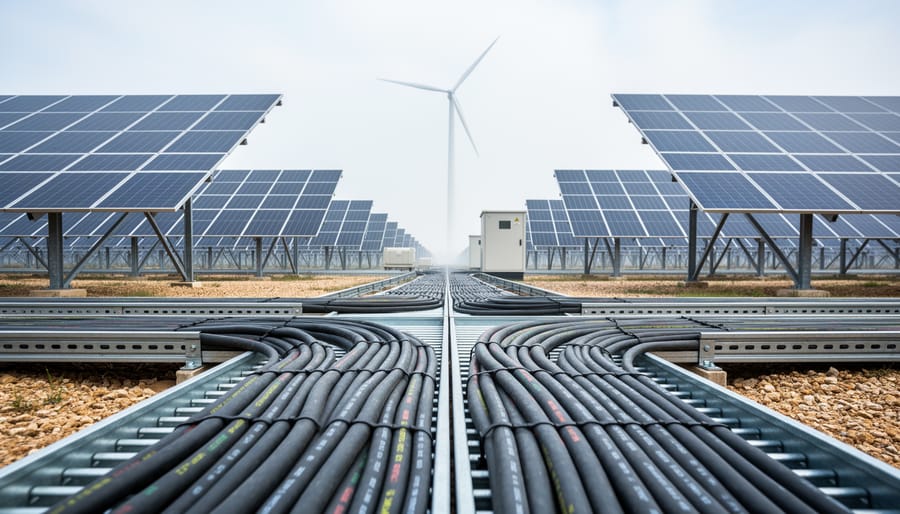
Power cable management is the systematic organization, routing, and protection of electrical cables within renewable energy installations to ensure safety, optimize performance, and extend infrastructure lifespan. In solar farms, wind facilities, and EV charging networks, proper cable management prevents power loss, reduces fire risk, and simplifies maintenance across systems that can span hundreds of acres and operate for decades.
The stakes are high. A single cable failure in a large-scale solar array can cascade into significant downtime and revenue loss. Wind farms operating in harsh coastal environments face constant exposure to salt, moisture, and mechanical stress. EV charging infrastructure demands rapid deployment while meeting stringent electrical codes. Each scenario requires specific cable management strategies that balance electrical performance with environmental resilience.
As clean energy markets expand throughout 2026, the complexity of power distribution systems grows proportionally. Modern renewable installations integrate thousands of connection points, multiple voltage levels, and diverse cable types, from DC solar strings to high-voltage AC transmission lines. Without structured cable management, these systems become maintenance nightmares prone to failures that undermine project economics.
This article provides a technical framework for power cable management in renewable energy applications. You’ll learn how effective cable management systems function, the components that form a complete solution, and application-specific considerations for solar, wind, and EV infrastructure. We’ll examine industry standards including those upheld through ISO 9001:2015 certification processes, and explore how proper cable management contributes to both operational efficiency and environmental sustainability by reducing material waste and extending system service life.
Power cable management in renewable energy refers to the systematic planning, organization, routing, protection, and support of electrical cables throughout solar, wind, and EV charging installations. Unlike standard commercial cable management, renewable energy systems demand specialized approaches that address high-voltage DC power transmission, prolonged outdoor exposure to UV radiation and temperature extremes, and the physical scale of utility-grade infrastructure spanning acres or distributed across wind farm layouts.
At its core, this discipline ensures that electrical cables remain safely secured, properly separated, and functionally accessible throughout the 25-to-30-year operational lifespan typical of renewable installations. The stakes are considerably higher than indoor commercial environments: a single cable failure in a solar array can cascade into significant energy production losses, while improper wind turbine cable routing can lead to mechanical damage from blade rotation and nacelle movement.
Several fundamental concepts define power cable management in renewable contexts:
The renewable energy context introduces unique requirements absent from general electrical work. Solar farms must manage thousands of DC cable runs from individual panels through combiner boxes to central inverters, all while preventing ground faults that compromise personnel safety. Wind installations face dynamic mechanical loads as nacelles rotate to track wind direction, requiring cable systems that accommodate continuous twisting without degradation. EV charging networks demand vandal-resistant outdoor installations that withstand repeated vehicle impacts and extreme weather while maintaining reliable power delivery.
Effective cable management starts long before installation. Engineers must size cables to handle expected loads while accounting for voltage drop, particularly critical in DC solar systems where long runs between arrays and inverters can reduce efficiency. Thermal management planning involves calculating heat dissipation rates and spacing requirements, densely packed cables in closed trays can exceed temperature ratings, degrading insulation and shortening cable life.
Expansion planning matters in renewable projects that grow incrementally. Sizing tray systems and conduits at 125% of initial capacity allows future additions without costly infrastructure replacement. This forward-thinking approach reduces material waste and long-term project costs.
Integration with electrical codes forms the foundation of compliant design. NEC Article 690 governs solar installations, specifying minimum separation distances, grounding requirements, and acceptable routing methods. UL-listed components ensure safety and insurability, while IEC standards facilitate international projects and cross-border equipment procurement.
Top Solar’s engineering support helps clients navigate these requirements during the planning phase. Our ISO 9001:2015-certified processes ensure design documentation, material specifications, and compliance verification follow consistent quality standards, reducing project risk and accelerating permitting timelines for renewable energy developments across North America.
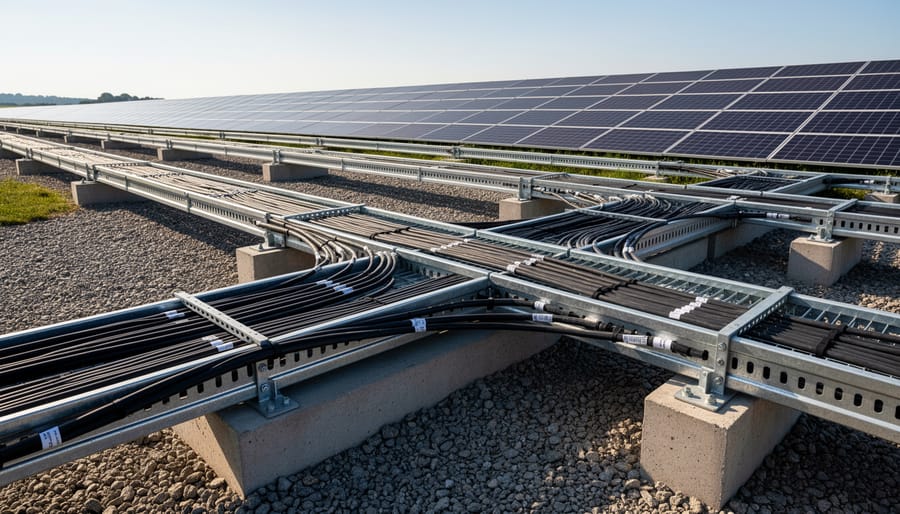
Once design is complete, installation transforms plans into physical infrastructure that will operate for decades. The process begins with selecting and mounting cable trays, perforated, ladder, or solid-bottom designs chosen based on cable weight, environmental exposure, and ventilation needs. In solar installations, aluminum trays resist corrosion better than steel in coastal environments, while ladder trays provide superior airflow for high-current DC runs.
Conduit systems protect cables in areas with mechanical risk or where direct burial is required. PVC works for underground runs in moderate climates, but HDPE or galvanized rigid metal conduit handles extreme temperature swings and physical stress better. Installers use UV-rated cable ties and stainless-steel fasteners to secure cables at regular intervals, typically every 24 to 36 inches, preventing sag and strain on terminations.
Labeling proves critical for maintenance and troubleshooting. Each cable receives durable tags identifying circuit number, voltage, and destination, while color-coded systems distinguish DC positive and negative conductors. Most important is maintaining separation: power cables run in dedicated trays at least 12 inches from control and communication lines, eliminating electromagnetic interference that degrades sensor accuracy and data transmission. Bonding all metallic components to ground completes the installation, creating multiple safety paths for fault currents.
Effective power cable management in renewable energy relies on a coordinated system of hardware components, each engineered to withstand the demanding conditions of outdoor installations while maintaining electrical integrity over decades of service. These components work together to route, protect, and organize cables across solar farms, wind facilities, and EV charging sites where exposure to sunlight, moisture, temperature swings, and mechanical stress is constant.
Cable trays and ladder systems form the backbone of most large-scale installations. These open-structure metal frameworks support multiple cables along their run from generation equipment to inverters and grid connections. In solar applications, aluminum or hot-dip galvanized steel trays resist corrosion while providing ventilation that prevents heat buildup in high-current DC circuits. Ladder-style trays offer superior airflow and are easier to modify during system expansions, making them a practical choice for utility-scale projects where cable routes may need adjustment as arrays grow.
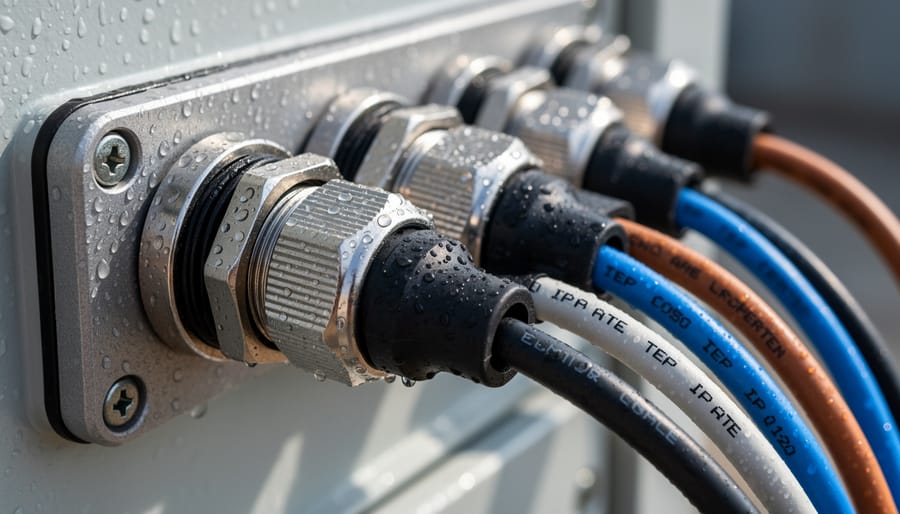
Cable glands and connectors seal entry points where cables pass through enclosures, junction boxes, or equipment housings. In renewable energy contexts, these components must maintain IP ratings of at least IP65 to prevent moisture ingress while accommodating the larger conductor sizes typical of high-voltage DC systems. Quality glands include strain relief features that prevent cable jacket damage from wind-induced movement or thermal expansion cycles.
Conduit and protective sleeving shield cables in areas where direct burial, overhead routing, or transition zones create vulnerability. Rigid metallic conduit offers maximum mechanical protection for underground runs beneath solar arrays, while flexible non-metallic conduit suits above-ground applications where routing around obstacles is necessary. UV-stabilized PVC and HDPE conduits maintain structural integrity under continuous sun exposure without becoming brittle, a critical consideration for installations with 25-year design lives.
Essential components for renewable energy cable management include:
Support brackets and clamps secure cables to structural elements while allowing controlled movement during thermal cycling. Stainless steel or corrosion-resistant polymer clamps spaced according to cable weight and flexibility prevent sagging that can stress connections or create tripping hazards during maintenance. In wind tower applications, specially designed cable carriers accommodate the twisting motion as nacelles track wind direction, preventing fatigue failure over millions of rotation cycles.
Grounding and bonding components establish the safety ground paths essential for renewable energy systems. Tinned copper lugs resist oxidation in wet environments, while bonding jumpers maintain electrical continuity across cable tray sections and equipment frames. These components must handle fault currents potentially exceeding thousands of amperes, making proper sizing and installation critical for personnel safety and equipment protection.
Solar power installations represent some of the most cable-intensive renewable energy examples with unique management requirements that vary by scale and configuration. Utility-scale solar farms face particular challenges routing thousands of DC cables from string arrays across extensive distances to central inverters, often spanning hundreds of acres. Proper management here requires UV-resistant cable trays elevated above ground to prevent moisture intrusion while allowing thermal dissipation and drainage. DC combiner boxes consolidate strings before transmission to inverters, creating concentration points where cable organization directly impacts maintenance accessibility and fault isolation.
Commercial rooftop systems demand different solutions given limited space, penetration minimization, and wind loading concerns. Cable routing follows roof structural members when possible, with conduit systems protecting cables from foot traffic and environmental exposure while maintaining code-required separation distances from roof edges. Ground-mount arrays introduce soil contact considerations and wildlife protection, requiring buried conduit runs or elevated cable management systems between rows.
String routing optimization reduces voltage drop and simplifies troubleshooting, with clear labeling protocols enabling rapid identification during maintenance. Array-to-inverter distances in large installations can exceed 1,500 feet, making cable sizing and support interval calculations critical to prevent mechanical stress and maintain electrical performance over decades of operation.
Wind turbines present distinct cable management challenges that set them apart from static solar installations. Inside the tower, power cables must run vertically from the nacelle at heights exceeding 100 meters while withstanding constant vibration and flexing. Specialized cable carriers and support systems prevent excessive movement, maintain minimum bend radius, and allow for thermal expansion as cables heat under load.
The nacelle itself requires twist cable management, as the turbine yaw system rotates to track wind direction, cables must accommodate repeated 360-degree rotations without damage. Counter-rotating cable loops or slip-ring assemblies prevent tangling and maintain electrical integrity through thousands of rotation cycles over the turbine’s lifespan.
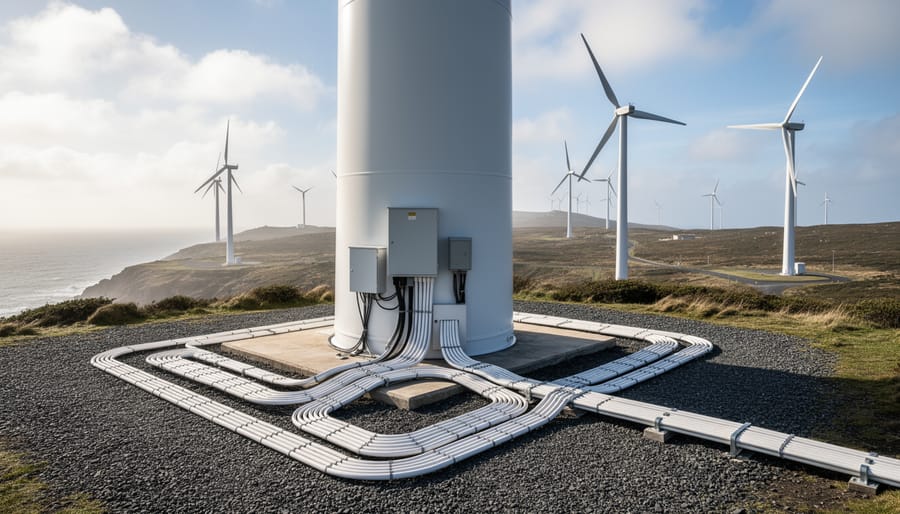
Beyond individual turbines, wind farm collector systems manage medium-voltage cables spanning kilometers between turbines and the central substation. Underground trenching protects these inter-array cables from weather exposure, but proper depth, bedding material, and separation distances become critical. Cable route planning must account for soil conditions, drainage patterns, and future access for repairs. Junction boxes at each turbine foundation require robust weather sealing and grounding to handle voltage transients from lightning strikes, which occur frequently at exposed wind farm sites.
EV charging infrastructure presents distinct cable management challenges that blend outdoor durability with high-power distribution requirements. Unlike stationary solar arrays, charging stations must accommodate frequent connection and disconnection cycles, vehicle impact risks, and public accessibility while delivering 50 kW to 350 kW per charging point.
Power distribution to multiple charging dispensers requires robust cable routing from grid connection points or battery storage systems to individual charging heads. Installers typically use underground conduit systems or overhead cable trays with UV-resistant insulation rated for continuous outdoor exposure. Cable sizing must account for voltage drop across distances and simultaneous charging loads during peak usage.
Weatherproofing becomes critical where cables emerge from ground level or connect to charging pedestals. Sealed cable glands, IP65-rated junction boxes, and strain relief fittings protect connections from rain, snow, and debris. In northern climates, cables need cold-temperature flexibility ratings to prevent insulation cracking.
Vandal resistance demands metal conduit guards around exposed cables and tamper-proof enclosures for termination points. Quick-disconnect features allow maintenance crews to isolate individual charging stations without shutting down entire facilities. Cable management also integrates monitoring systems for fault detection, enabling remote diagnostics and reducing downtime in commercial charging networks.
Power cable management in renewable energy must comply with a rigorous framework of national and international standards that govern electrical safety, component performance, and environmental durability. In North America, NEC Article 690 sets forth specific requirements for photovoltaic systems, covering conductor sizing, overcurrent protection, grounding, and cable routing from arrays to inverters and grid connections. Wind and EV installations follow related NEC articles alongside OSHA workplace safety regulations that mandate proper cable support and clearance distances.
Component-level compliance relies heavily on UL certifications. Cable trays, conduits, connectors, and enclosures must carry appropriate UL listings (such as UL 2703 for solar mounting systems or UL 2251 for cable management accessories) to demonstrate they have passed standardized fire, mechanical, and electrical stress testing. IEC standards provide parallel international benchmarks, particularly IEC 60364 for low-voltage electrical installations and IEC 62852 for connectors in photovoltaic systems, ensuring compatibility across global supply chains and multinational projects.
Environmental ratings classify how well cable management hardware withstands outdoor exposure. IP (Ingress Protection) ratings indicate resistance to dust and moisture, IP65 or higher is standard for solar and wind applications exposed to rain, snow, and airborne particulates. NEMA enclosure ratings serve a similar function in North America, with NEMA 3R and 4X designations common for outdoor renewable energy installations requiring corrosion resistance and weatherproofing.
Top Solar’s ISO 9001:2015 certification underpins these compliance requirements by embedding quality control and traceability into every stage of the trusted supply chain. This systematic quality management ensures that cable management components meet or exceed applicable standards, documentation is complete for inspections and audits, and clients receive products that perform reliably over the decades-long lifespan expected in renewable energy infrastructure.
DO NOT USE THIS HEADING OR ANY HEADING IN YOUR RESPONSE
Renewable energy projects demand robust cable management systems, yet professionals frequently encounter similar challenges during design, installation, and maintenance phases. Understanding these common concerns helps ensure optimal performance and long-term reliability.
Cable trays work best for high-volume installations requiring frequent access and modifications, typical in solar farms and substations. Conduit provides superior protection in areas with extreme weather exposure, direct burial applications, or where physical security against vandalism is essential for EV charging stations.
Plan quarterly visual inspections for exposed systems checking for UV degradation, loose fasteners, and wildlife damage. Schedule comprehensive assessments annually, examining grounding integrity, thermal performance, and component wear, with additional checks after severe weather events.
Specify cable trays with ventilated designs allowing maximum airflow, increase conductor sizing to reduce resistive heating, and use materials rated for extended temperature ranges. Position cables to avoid direct ground reflection heat and consider white or reflective tray finishes to minimize solar absorption.
Size cable trays and conduits at 125-150% of initial capacity, install spare conduit runs during initial construction, and document routing paths with as-built drawings. Leave expansion loops at junction points and select modular tray systems that allow straightforward extensions without disturbing operational cables.
Higher-grade systems with corrosion-resistant finishes, superior UV stability, and robust construction typically deliver 25-30 year service life versus 10-15 years for basic alternatives. This longevity reduces replacement costs, minimizes downtime during repairs, and lowers total lifecycle expenses in utility-scale renewable projects.
Cable twist from nacelle rotation creates the most common issue, requiring twist-compensating management systems and regular tension monitoring. Vibration fatigue at support points and moisture ingress through damaged cable glands also contribute to premature failures in tower environments.
Material selection significantly impacts performance across renewable energy applications. Engineers working on coastal wind farms prioritize stainless steel or heavily galvanized components resisting salt spray corrosion, while desert solar installations focus on UV-resistant polymers and thermal expansion characteristics. Understanding your specific environmental stressors guides appropriate component choices that balance initial investment against maintenance requirements and expected service life.
Troubleshooting typically starts with visual inspection of physical damage, followed by thermal imaging to identify hot spots indicating overcrowding or poor contact points. Grounding continuity testing confirms electrical safety, while documentation review ensures installations meet original design specifications and haven’t been compromised by field modifications.
Effective power cable management stands as a non-negotiable foundation for renewable energy infrastructure that must perform reliably for 25 years or longer. The discipline extends far beyond simple organization, it directly determines electrical safety, system efficiency, equipment longevity, and operational continuity across solar farms, wind facilities, and EV charging networks. When cables are properly routed, protected, and maintained, renewable energy installations deliver consistent performance while minimizing fire risks, ground faults, and costly downtime that can derail project economics.
The sustainability case for rigorous cable management is equally compelling. Well-designed systems reduce material waste through optimized cable runs and right-sized components. Protected cables resist environmental degradation, extending service life and delaying replacement cycles. Proper organization simplifies maintenance and emergency response reducing the carbon footprint of ongoing operations. These benefits align perfectly with the renewable energy sector’s mission to deliver clean power while minimizing resource consumption throughout the project lifecycle.
Top Solar brings ISO 9001:2015-certified quality management to every cable management solution we supply to North America’s renewable energy sector. Our engineering support, component sourcing, and commitment to sustainability help project teams implement cable management systems that meet rigorous standards while supporting long-term operational success. Whether you’re designing a utility-scale solar installation, wind farm collector system, or EV charging network, our expertise ensures your cable management infrastructure performs as reliably as the renewable energy systems it supports.