
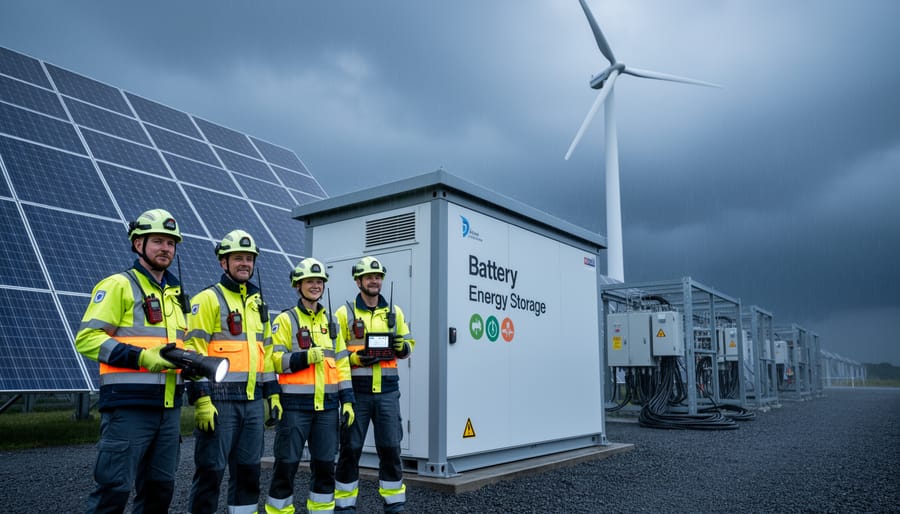
Emergency response service in renewable energy means having a documented plan, trained personnel, and pre-positioned resources to contain and resolve equipment failures, severe weather damage, or safety incidents at solar arrays, wind farms, and battery storage facilities within hours, not days. Effective response limits downtime, protects personnel, and preserves project economics by ensuring rapid emergency component access and coordinated action during fires, structural collapses, electrical faults, or environmental releases.
For facility managers and safety officers overseeing renewable energy examples across North America, the stakes are clear. A single uncontrolled battery thermal event can idle an entire installation for weeks. A wind turbine blade failure during peak production season directly impacts revenue. The difference between minor disruption and major loss lies in preparedness: knowing which scenarios trigger emergency protocols, maintaining ISO 9001:2015-certified supply chains for critical spares, and rehearsing response procedures before an incident occurs.
This article defines what constitutes an emergency in renewable operations, outlines triggering scenarios specific to solar, wind, and storage systems, and provides a step-by-step framework for building response plans that align with operational realities. You’ll find actionable checklists for supply chain readiness, benchmarks for response time expectations, and practical answers to the most common questions facing renewable energy professionals responsible for site safety and continuity in 2026.
Effective emergency response in renewable energy operations rests on four interconnected pillars that determine how quickly and successfully teams can address critical incidents. Each component must function reliably under pressure, because failures compound rapidly in energy systems where downtime directly impacts safety, revenue, and grid stability.
Communication Infrastructure
Real-time communication systems form the backbone of any emergency response. Redundant notification channels, including automated alerts, direct phone lines, and radio systems, ensure that the right personnel receive incident reports immediately, regardless of network conditions. Modern renewable facilities deploy monitoring platforms that detect anomalies and trigger escalation protocols automatically, cutting initial response time from hours to minutes. These systems must function independently of the main power grid, with battery backup and satellite connectivity built in.
Strategic Component Inventory
Pre-positioned spare parts directly determine restoration speed. Critical components, inverters, combiner boxes, cable assemblies, connectors, and control modules, must be readily available, not ordered after failure occurs. Facilities typically maintain inventory based on failure rate analysis and lead time calculations, storing components that combine high criticality with long procurement cycles. Quality standards matter intensely here; ISO 9001:2015-certified components reduce the risk of secondary failures during emergency repairs when technicians work under time pressure.
Trained Response Personnel
Technical expertise separates effective emergency response from prolonged outages. Response teams require specific training in renewable energy systems, electrical safety protocols, and emergency procedures. This includes both on-site personnel who can provide immediate assessment and specialized technicians who handle complex repairs. Regular drills and scenario training ensure teams maintain readiness, particularly for rare but high-impact events.
Deployment Protocols and Decision Frameworks
Clear, pre-established procedures eliminate decision paralysis during emergencies. Response protocols specify who gets notified, in what sequence, under what conditions, and with what authority to act. These frameworks include severity classification systems, escalation thresholds, safety checkpoints, and restoration priority hierarchies. Documented protocols also ensure consistency across shifts and personnel changes, preventing knowledge gaps from compromising response effectiveness.
These components function as an integrated system rather than standalone elements. Communication systems activate trained personnel, who execute established protocols using pre-positioned inventory to restore operations safely and efficiently.
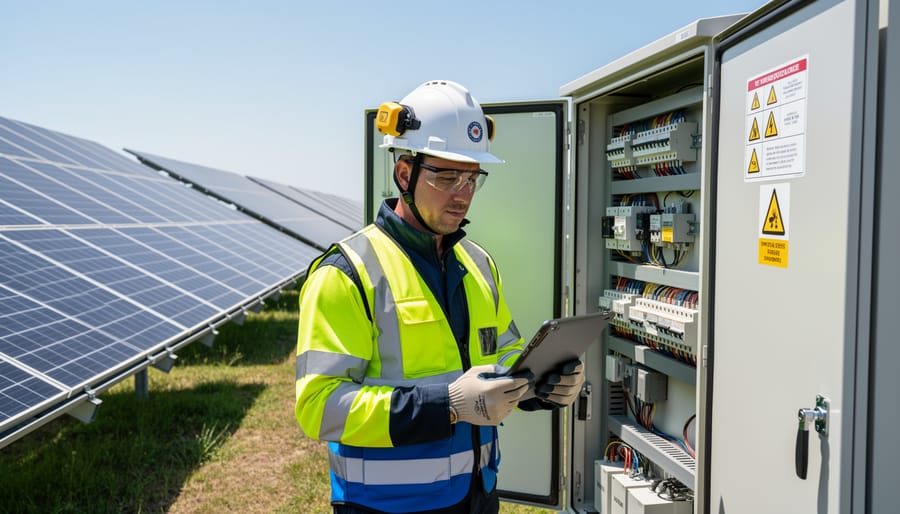
Inverter failures represent the most common equipment emergency in solar installations, capable of halting power generation across entire arrays within minutes. When an inverter trips offline, immediate diagnosis is essential, the failure might stem from internal component degradation, overheating, or grid communication errors. Response teams must carry replacement power modules, control boards, and cooling fans to restore operation quickly. Understanding how renewable systems work helps technicians isolate whether the inverter failure is symptomatic of a broader system issue or a standalone component breakdown.
Cable damage poses severe safety risks alongside operational losses. Physical degradation from rodents, moisture intrusion at termination points, or mechanical stress from thermal cycling can create arc faults or complete circuit failures. Emergency protocols demand immediate isolation of damaged cable sections and temporary bypasses where feasible. Connector failures, though smaller in scale, cascade rapidly, a single faulty MC4 connector introduces resistance that generates heat, potentially igniting nearby materials or triggering protective shutdowns across connected strings.
Structural issues require the fastest response times. Mounting system failures during wind events, tracker actuator breakdowns, or foundation settling threaten both equipment and personnel. Emergency teams must secure unstable structures before attempting electrical repairs, often requiring specialized rigging equipment and engineering assessments to prevent catastrophic collapse.
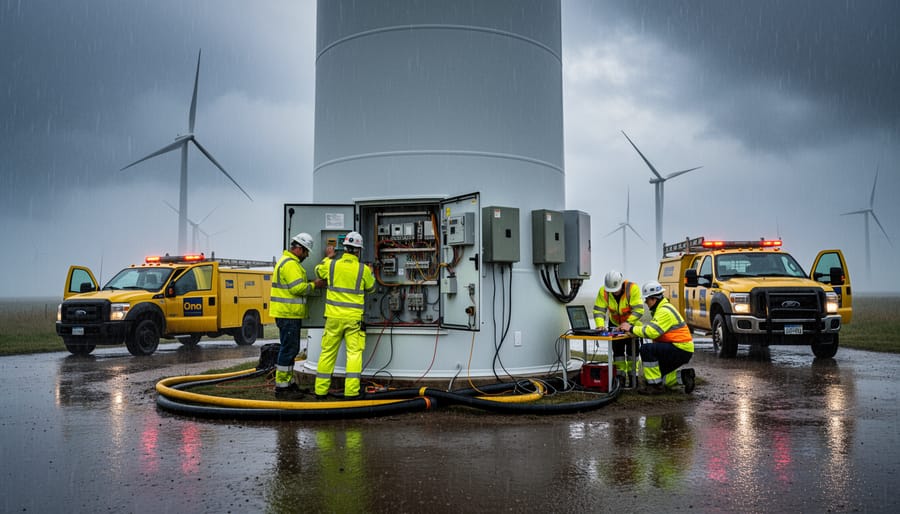
Severe weather represents the most frequent trigger for emergency response in renewable energy operations. Storm systems can deliver multiple simultaneous threats: high winds exceeding design loads damage solar arrays and wind turbine components, hail penetrates module surfaces creating immediate performance degradation, and lightning strikes compromise electrical systems despite protection measures. Response teams must assess structural integrity, electrical safety, and fire risk before beginning restoration work.
Extreme temperature events create distinct challenges. Heat waves above 50°C can cause thermal runaway in battery storage systems, requiring immediate cooling protocols and potential emergency shutdown. Conversely, sub-zero temperatures combined with ice accumulation increase structural loads while reducing component performance, often necessitating deicing operations and thermal protection deployment.
Flooding triggers layered emergency protocols: electrical isolation prevents arc flash hazards, while rapid assessment determines whether water has penetrated critical components like inverters or transformers. Sites in flood-prone regions maintain elevated equipment platforms and waterproof enclosures, but emergency teams still face complex decisions about safe restoration sequences.
Fire risk escalates during dry conditions, particularly at sites surrounded by vegetation. Emergency plans include perimeter defense, equipment shutdown protocols, and coordination with local fire services trained in renewable energy hazards. Prevention through vegetation management and spark-resistant equipment selection reduces but cannot eliminate the need for fire emergency preparedness.
Grid disruptions present unique challenges for renewable installations because they affect both facility safety and grid stability obligations. When the utility grid fails, solar and wind systems must disconnect immediately to prevent backfeeding, a safety protocol that also halts power generation. Emergency response teams need to verify isolation, assess reconnection readiness, and coordinate with utility operators before restoration.
Islanding events require particularly swift action. If a renewable facility continues operating while isolated from the grid, voltage and frequency can drift dangerously out of specification, damaging both the installation’s equipment and connected loads. Response protocols must include real-time monitoring of grid status, automatic disconnection systems, and clear communication channels with grid operators.
Power quality emergencies, voltage sags,harmonics, or frequency deviations, demand immediate investigation to determine whether the renewable installation is the source or victim of the disturbance. Teams need power analyzers, load data, and inverter logs to diagnose root causes within minutes, preventing equipment damage and maintaining grid code compliance.
Building an emergency response plan for renewable energy installations requires a methodical approach that addresses the unique challenges of distributed energy assets. Unlike conventional facilities, solar and wind sites often operate across multiple locations, depend on specialized components, and must maintain grid compliance even during emergencies. Your response plan must account for these complexities while ensuring rapid restoration capability.
The planning process follows a logical progression from identifying vulnerabilities through maintaining operational readiness:
Documentation proves critical throughout this process. Your response plan needs physical copies at each site, accessible even when power and communications fail. Include equipment specifications, vendor contacts with account numbers, schematic diagrams, and supplier part numbers for critical components. Many facilities discover during actual emergencies that digital-only documentation becomes inaccessible precisely when needed most.
Integration with existing operations distinguishes effective plans from shelf documents. Your maintenance team should reference emergency procedures during routine work, your procurement processes should align with stocking requirements, and your training calendar should include emergency scenarios alongside standard operations. When response protocols exist separately from daily workflows, they quickly become outdated and unfamiliar.
Testing reveals gaps that planning sessions miss. Realistic drills expose communication breakdowns, highlight missing tools or components, and identify personnel who need additional training. Schedule these exercises during off-peak production periods, but make them challenging enough to stress-test your procedures. A drill that everyone passes easily probably isn’t revealing the weaknesses you need to address.
Post-incident reviews complete the cycle. After every emergency response, gather your team to analyze what worked, what failed, and what surprised you. Update your plan immediately with these insights rather than waiting for the quarterly review. The best emergency response plans evolve continuously, incorporating real-world experience into progressively more effective protocols.
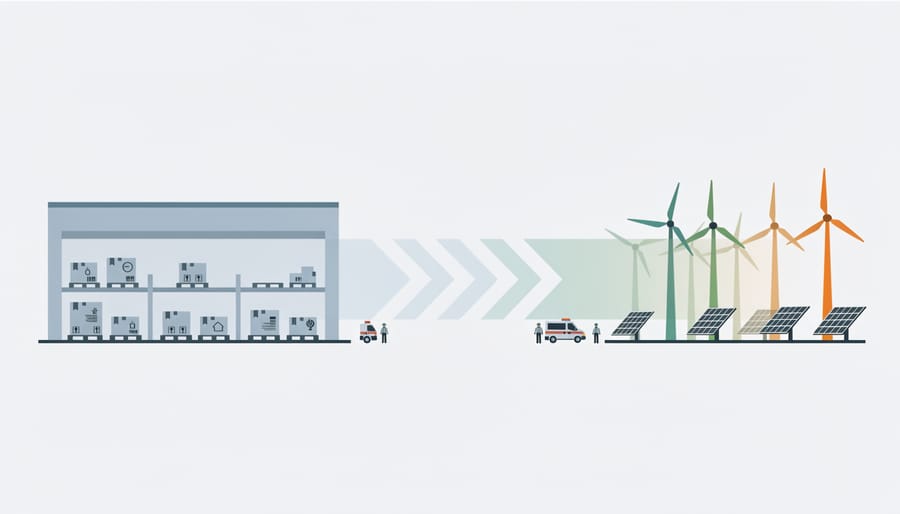
Emergency response effectiveness hinges on immediate access to the right components. When an inverter fails at 2 AM or a connector melts during peak production hours, your procurement strategy determines whether you’re back online in hours or waiting days for parts. Facilities that maintain strategic spare inventory and partner with a trusted supply chain consistently achieve restoration times 60-70% faster than those relying on just-in-time ordering or single-source vendors.
Pre-positioned inventory should focus on high-failure components and items with long lead times. Stock critical inverter modules, MC4 connectors, combiner box fuses, and essential cable assemblies based on your facility’s equipment profile and failure history. Calculate quantities using your mean time between failures data and target a 48-hour restoration window for common scenarios. This isn’t excessive inventory, it’s insurance that pays dividends when emergencies strike.
Vendor relationships matter as much as the parts themselves. Establish agreements with suppliers who maintain North American stock, offer expedited shipping, and provide technical support during installations. Verify their quality certifications, ISO 9001:2015 certification indicates systematic quality management that reduces the risk of receiving defective components during crisis situations when verification time is minimal.
Document your supply chain contacts and part numbers in your emergency response plan. Include after-hours contact information, account numbers, and pre-approved purchase order protocols so night-shift operators can order components without waiting for procurement approval. Test these processes annually with simulated emergencies.
Cross-reference your critical spare parts list with suppliers’ stock levels quarterly. Supply chain disruptions don’t pause for your emergencies. Diversify across multiple qualified vendors for essential components, and negotiate stocking agreements that guarantee availability for your most critical needs. When seconds count in safety situations, component access becomes a competitive advantage.
Industry standards for emergency response in renewable energy typically categorize incidents by severity, with each tier carrying specific response time expectations and escalation protocols.
| Severity Level | Acknowledgment Target | On-Site Arrival Target | Resolution Timeframe |
|---|---|---|---|
| Critical | 15 minutes | 2-4 hours | 24-48 hours |
| High | 30 minutes | 4-8 hours | 48-72 hours |
| Medium | 2 hours | 24 hours | 5-7 days |
| Low | 4 hours | 48 hours | 7-14 days |
Critical incidents, those involving safety hazards, complete system failures, or grid compliance violations, demand immediate acknowledgment and rapid deployment. Many operators maintain 24/7 emergency contacts and pre-positioned response teams to meet these aggressive targets.
Performance tracking should extend beyond simple response times. Leading organizations measure first-time fix rates, parts availability impact on restoration times, and mean time between failures for emergency-prone components. They also track restoration quality: how often emergency repairs require follow-up work within 30 days.
Continuous improvement comes from systematic incident reviews. After each emergency response, gather data on what delayed restoration, which components failed, whether spare inventory was adequate, and if communication protocols worked as intended. This analysis reveals patterns, perhaps a specific inverter model fails predictably under heat stress, or certain connectors show vulnerability during extreme weather.
Geographic factors significantly influence realistic targets. A utility-scale solar farm in rural Nevada faces longer on-site arrival times than a commercial rooftop system in Los Angeles. Set benchmarks that reflect your infrastructure’s location while still pushing for efficiency. Some operators establish regional response hubs or maintain relationships with multiple service providers to reduce arrival times across distributed portfolios.
An emergency requires immediate action to prevent safety hazards, significant production loss, or equipment damage, such as inverter failures, electrical faults, or storm damage. Routine maintenance is scheduled work that doesn’t threaten immediate safety or operations, like planned inspections or component replacements during normal operating windows.
Critical components like inverters, connectors, and high-voltage cables should have at least one backup unit on-site, with secondary stock accessible within 24 hours. Facilities should assess their risk profile and downtime costs to determine appropriate inventory levels, balancing storage costs against potential revenue losses from extended outages.
A complete team includes electrical engineers, field technicians with high-voltage training, safety officers, procurement specialists with supply chain contacts, and a designated emergency coordinator. Each member should have clear responsibilities, backup contacts, and authority to make decisions within their domain during emergencies.
Conduct tabletop exercises quarterly and full-scale drills at least twice annually, varying scenarios to test different aspects of your plan. After any actual emergency, review and update protocols based on lessons learned to continuously improve response effectiveness.
These questions reflect the practical concerns facility managers face when developing emergency preparedness strategies. Testing frequency matters because untested plans rarely work smoothly when real emergencies strike, teams need muscle memory for their roles, and systems require validation under simulated stress.
Documentation requirements deserve attention too. After any emergency event, capture timestamps, actions taken, equipment replaced, costs incurred, and recovery timeline. This record serves multiple purposes: regulatory compliance, insurance claims, performance analysis, and plan refinement. Many facilities maintain digital incident logs that feed directly into their maintenance management systems.
Weather forecast integration has become increasingly sophisticated. Modern facilities connect meteorological services to their monitoring systems, triggering pre-emptive actions when severe weather approaches. This might mean securing loose equipment, pre-positioning response teams, or coordinating with grid operators about potential islanding procedures. The goal is moving from reactive response to proactive readiness.
Emergency preparedness in renewable energy operations rests on four foundational pillars that every facility manager must address. First, establish relationships with reliable component suppliers before emergencies strike, procurement speed during a crisis depends entirely on partnerships built during normal operations. ISO 9001:2015 certified suppliers provide the quality assurance that reduces emergency frequency while ensuring rapid replacement when failures occur.
Second, invest in comprehensive training programs that extend beyond your immediate operations team. Contractors, maintenance personnel, and even administrative staff should understand basic emergency protocols and communication channels. Quarterly drills using realistic scenarios reveal gaps in your response plans that tabletop exercises miss entirely.
Third, maintain appropriate spare component inventory based on failure mode analysis and lead time calculations. Critical items like inverters, connectors, and protection devices require pre-positioning, especially for remote installations where same-day delivery isn’t feasible. Balance carrying costs against downtime risks specific to your facility’s revenue model and contractual obligations.
Fourth, integrate emergency response planning with your broader sustainability and financial strategies. Clean energy funding agreements often include uptime requirements that emergency preparedness directly supports, demonstrating robust response capabilities strengthens both operational resilience and investor confidence. Document your response protocols, track performance metrics, and update procedures after every incident to build organizational learning that compounds over time.
Effective emergency response services do more than minimize downtime, they protect substantial capital investments, ensure worker and community safety, and maintain the reliability that renewable energy infrastructure demands. Facilities operating without tested emergency protocols face extended outages, compounded repair costs, and potential safety incidents that undermine both financial performance and sustainability objectives.
Preparedness begins long before an emergency strikes. Reliable component sourcing establishes the foundation: when critical failures occur, having immediate access to quality inverters, cables, connectors, and mounting hardware determines whether restoration takes hours or weeks. Equally essential are trained response teams who understand your specific installation, documented protocols that guide rapid decision-making, and supplier partnerships that deliver components when urgency matters most.
Top Solar supports emergency readiness through responsive supply chain services backed by ISO 9001:2015 certification. Our inventory systems ensure critical solar components remain accessible during urgent situations, while our quality standards guarantee that replacement parts perform reliably under pressure. We recognize that emergency preparedness isn’t just about reactive response, it’s about proactive partnerships that keep renewable energy facilities operational, safe, and advancing North America’s clean energy transition even when unexpected challenges arise.